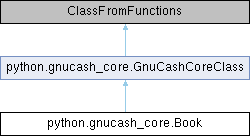
Public Member Functions | |
| InvoiceLookup (self, guid) | |
| EntryLookup (self, guid) | |
| CustomerLookup (self, guid) | |
| JobLookup (self, guid) | |
| VendorLookup (self, guid) | |
| EmployeeLookup (self, guid) | |
| TaxTableLookup (self, guid) | |
| TaxTableLookupByName (self, name) | |
| TaxTableGetTables (self) | |
| BillLookupByID (self, id) | |
| InvoiceLookupByID (self, id) | |
| CustomerLookupByID (self, id) | |
| VendorLookupByID (self, id) | |
| InvoiceNextID (self, customer) | |
| BillNextID (self, vendor) | |
| CustomerNextID (self) | |
| VendorNextID (self) | |
 Public Member Functions inherited from python.gnucash_core.GnuCashCoreClass Public Member Functions inherited from python.gnucash_core.GnuCashCoreClass | |
| do_lookup_create_oo_instance (self, lookup_function, cls, *args) | |
Additional Inherited Members | |
| Static Protected Attributes inherited from python.gnucash_core.GnuCashCoreClass | |
| _module = gnucash_core_c | |
Detailed Description
A Book encapsulates all of the GnuCash data, it is the place where
all GnuCash entities (Transaction, Split, Vendor, Invoice...), are
stored. You'll notice that all of the constructors for those entities
need a book to be associated with.

The most common way to get a book is through the book property in the
Session class, that is, create a session that connects to some storage,
such as through 'my_session = Session('file:my_books.xac')', and access
the book via the book property, 'my_session.book'

If you would like to create a Book without any backing storage, call the
Book constructor without any parameters, 'Book()'. You can later merge
such a book into a book with actual store by using merge_init.

Methods of interest
get_root_account -- Returns the root level Account
get_table -- Returns a commodity lookup table, of type GncCommodityTable
Definition at line 433 of file gnucash_core.py.
Member Function Documentation
◆ BillLookupByID()
| python.gnucash_core.Book.BillLookupByID | ( | self, | |
| id | |||
| ) |
Definition at line 496 of file gnucash_core.py.
◆ BillNextID()
| python.gnucash_core.Book.BillNextID | ( | self, | |
| vendor | |||
| ) |
Return the next Bill ID.
Definition at line 522 of file gnucash_core.py.
◆ CustomerLookup()
| python.gnucash_core.Book.CustomerLookup | ( | self, | |
| guid | |||
| ) |
Definition at line 462 of file gnucash_core.py.
◆ CustomerLookupByID()
| python.gnucash_core.Book.CustomerLookupByID | ( | self, | |
| id | |||
| ) |
Definition at line 506 of file gnucash_core.py.
◆ CustomerNextID()
| python.gnucash_core.Book.CustomerNextID | ( | self | ) |
Return the next Customer ID.
Definition at line 527 of file gnucash_core.py.
◆ EmployeeLookup()
| python.gnucash_core.Book.EmployeeLookup | ( | self, | |
| guid | |||
| ) |
Definition at line 477 of file gnucash_core.py.
◆ EntryLookup()
| python.gnucash_core.Book.EntryLookup | ( | self, | |
| guid | |||
| ) |
Definition at line 457 of file gnucash_core.py.
◆ InvoiceLookup()
| python.gnucash_core.Book.InvoiceLookup | ( | self, | |
| guid | |||
| ) |
Definition at line 452 of file gnucash_core.py.
◆ InvoiceLookupByID()
| python.gnucash_core.Book.InvoiceLookupByID | ( | self, | |
| id | |||
| ) |
Definition at line 501 of file gnucash_core.py.
◆ InvoiceNextID()
| python.gnucash_core.Book.InvoiceNextID | ( | self, | |
| customer | |||
| ) |
Return the next invoice ID.
Definition at line 516 of file gnucash_core.py.
◆ JobLookup()
| python.gnucash_core.Book.JobLookup | ( | self, | |
| guid | |||
| ) |
Definition at line 467 of file gnucash_core.py.
◆ TaxTableGetTables()
| python.gnucash_core.Book.TaxTableGetTables | ( | self | ) |
Definition at line 492 of file gnucash_core.py.
◆ TaxTableLookup()
| python.gnucash_core.Book.TaxTableLookup | ( | self, | |
| guid | |||
| ) |
Definition at line 482 of file gnucash_core.py.
◆ TaxTableLookupByName()
| python.gnucash_core.Book.TaxTableLookupByName | ( | self, | |
| name | |||
| ) |
Definition at line 487 of file gnucash_core.py.
◆ VendorLookup()
| python.gnucash_core.Book.VendorLookup | ( | self, | |
| guid | |||
| ) |
Definition at line 472 of file gnucash_core.py.
◆ VendorLookupByID()
| python.gnucash_core.Book.VendorLookupByID | ( | self, | |
| id | |||
| ) |
Definition at line 511 of file gnucash_core.py.
◆ VendorNextID()
| python.gnucash_core.Book.VendorNextID | ( | self | ) |
Return the next Vendor ID.
Definition at line 532 of file gnucash_core.py.
The documentation for this class was generated from the following file: